Showing posts with label Fresh Air. Show all posts

Friday, March 25, 2022

From Constance Baker Motley to KBJ


It's been a stressful week watching the disrespectful confirmation hearings of Judge Ketanji Brown Jackson--not to mention continued slaughter in Ukraine.

But let's talk for a moment about Judge Jackson's heroine and role model, Constance Baker Motley.  

Judge Jackson cited this prominent Black female judge during her acceptance speech after President Biden nominated her to be the next justice added to the Supreme Court.

"She was the first African American woman to argue a case before the Supreme Court, and the first to serve as a federal judge," according to this article on uscourts.gov.  

Judge Motley would have been an excellent nominee to the Supreme Court, but the nation wasn't there yet.  She wrote much of the 1954 decision Brown v. Board of Education.
Terry Gross featured an interview with Constance Baker Motley's biographer Tomiko Brown-Nagin on NPR's Fresh Air, Feb. 16.   

Brown-Nagin mentions that Motley knew civil rights activist Medgar Evers and mourned deeply when he was murdered.


I also heard this report on NPR's Code Switch, which mentions that Judge Motley avoided the term "feminist" in the 1970s and '80s, but she argued cases that were very important for women's equality.

"Despite the Ludtke v Kuhn case, and other efforts to provide equal consideration for women in the workplace, Motley rejected the label feminist—even though some famous feminists, like Shirley Chisolm and Bella Abzug—were friends and colleagues", the report says.

Civil Rights Queen: Constance Baker Motley and the Struggle for Equality is the title of Brown-Nagin's biography, which came out in January, 2022.  Judge Motley also wrote her own autobiography.  

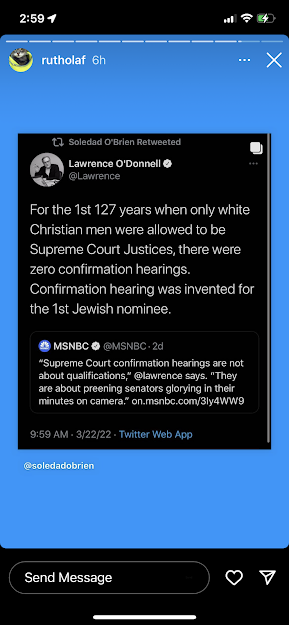
Here's a historical note to ponder: there were no confirmation hearings for the first 127 years of the Supreme Court.  White men were just nominated and debated a little in the Senate; then the vote took place on whether to confirm them.

In 1916 when a Jewish man was nominated, the Senate decided to hold a hearing to thoroughly vet this alarming new kind of nominee. See the history explained in the Insider.

Sunday, April 10, 2016

Yitzhak Rabin: What if he had not been shot?


Browsing newly published books at the LA Times Festival of Books this weekend, I couldn't resist buying the one about Yitzhak Rabin's assassination.  It looked like an eye-opener.

A few hours later it won the LA Times award for best book of history book written in 2015 as I sat in the audience at Bovard Auditorium on the USC campus.

Dan Ephron, Killing a King: The Assassination of Yitzhak Rabin and the Remaking of Israel (W. W. Norton and Co.)

Here's what the LA Times says about the book:
"Ephron's deeply researched tome recounts the events of Rabin's assassination and how it affected Middle Eastern geopolitics."

The prologue describes a few moments in the life of Rabin on the morning of November 4, 1995.  He had an eye infection; he cancelled his usual Saturday tennis match and an eye doctor paid a house call.  

It also describes the visit to a synagogue that morning of two Orthodox, violently nationalist brothers who were planning to kill Rabin.

Then Chapter 1 begins with Rabin in 1993, skeptical about whether to fly to Washington to attend the signing of a peace agreement between his government and the Palestine Liberation Organization.

The 12-page document "ended the state of belligerency between Israel and the PLO, promised to upend a quarter century of Israeli policy toward Palestinians in the West Bank and Gaza Strip, and created an opening for resolving the broader Arab-Israeli conflict," writes Dan Ephron (p. 8).

Ephron was present at the peace rally where Rabin was shot--he was a reporter covering it for Reuters and had just left the rally at 9:30 pm when the shooting occurred (p. 243).

This book is a page-turner.  

Because he was there in 1995 and later served as the Newsweek bureau chief in Jerusalem, and then researched this book, Ephron is the perfect person to pose the question: what if Rabin had not been assassinated?  

Would Israel and Palestine be closer to peace now?

Terry Gross asked him that question on Fresh Air last October.

http://www.npr.org/2015/10/13/448269886/revisiting-rabins-assassination-and-the-peace-that-might-have-been

The answer can never be known, but one thing is sure: things would not be as bad as they are now between the two groups of people. 

When I reminded a pro-Netanyahu friend that some Israelis do want negotiations for peace with Palestine, her answer was: "There are always self-hating Jews."